March 2000

JEWELRY INSURANCE ISSUES (formerly IM News), provides monthly insight and information for jewelry insurance agents, underwriters and claims adjusters.

Subscribe to
Jewelry Insurance Issues

Table of Contents

Click on article titles in red

2008

GARNET and Its Many Incarnations - January

Organic Gems - February

Do your jewelry claim settlements make you look bad? - March

Don’t Be Duped by Fake JISO Appraisal - April

Diamonds in the Rough - May

The Cultured Club - June

Sapphire—Gem Superstar - July

It’s a Certified Diamond! 
— But who's saying so?
- August

2007

Moissanite's New Spin - January

Online Jewelry - Buying and Insuring - February

Blood Diamonds - March

Damaged Jewelry, Don't Assume!- April

Chocolate Pearls - May

Appraisal Puff-Up vs Useful Appraisal - June

It's Art, but it is Jewelry?
- July

Diamonds Wear Coats of Many Colors - August

DANGER!  eBay Jewelry "Bargains" - September

TV Shopping for Jewelry - October

Enhanced Emeralds - November

Rubies: Leaded or Unleaded? December

2006

The New Platinum: A Story of Alloys - January

Ruby Ruse - February

How Big are Diamonds Anyway? - March

GIA Diamond Scandal
Has Silver Lining for Insurers
- April

Watch Out for Big-Box Retailers Insurance Appraisals - May

Mixing It Up: Natural and Synthetic Diamonds Together - June

Tanzanite - Warning: Fragile - July

Red Diamomds - August

Inflated Valuations & Questionable Certificates - September

Emeralds - October

Where Do Real Diamonds Come From? - November

Counterfeit Watches — The Mushroom War - December

2005

The Lure of Colored Diamonds - January

Synthetic Colored Diamonds - February

Watches: What to Watch for - March

When is a Pear not a Pair? - April

The Truth About Topaz - May

White Gold: How White is White? - June

One of a Kind — or Not - July

Jewelry in Disguise - August

Valued Contract for Jewelry? Proceed with Caution! - September

Antiques, Replicas and All Their Cousins
October

Grading the Color of Colored Diamonds
November

New GIA Cut Grade for Diamonds - December

2004

Synthetic Diamonds — and Insuring Tips - January

Bogus Appraisals and Fraud - February

A Picture is Worth Thousands of Dollars - March

Don't be Duped by Fracture Filling - April

Gem Scams Point to Need for Change - May

What is a Good Appraisal - June

4Cs of Color Gemstones - July

Gem Laser Drilling: The Next Generation - August

Why Update an Appraisal? - September

When to Recommend an Appraisal Update or a Second Appraisal - October

Secrets of Sapphire - November

Will the Real Ruby Please Stand Up - December

2003

Mysterious Orient:
A Tale of Loss
- January

Bogus Diamond Certificates and Appraisals - February

Can Valuations be Trusted? - March

Spotting a Bogus Appraisal or Certificate - April

Counterfeit Diamond Certificates - May

Case of the Mysterious "Rare" Sapphires - June

Politically Correct Diamonds - July

Name Brand Diamonds - September

Princess Cut: Black Sheep of Diamonds - October

Reincarnate as a Diamond - November

Synthetic Diamonds - December

2002

Irradiated Mail/Irradiated Gems - January

Fake Diamonds (Moissonite) - February

GIA Diamond Report - March

AGS and Other Diamond Certificates - April

Colored Stone Certificates - May

Damaged Jewelry: Don't Pay for Nature's Mistakes - June

The Case of the "Self-Healing" Emerald - July

Mysterious Disappearance: Case of the Missing Opals - August

The Discount Mirage - September

What Can You Learn from Salvage? - October

Gaining from Partial Loss - November

Year in Review - December

2001

Colored Diamonds - January

Good as Gold - February

Disclose Gem Treatments - March

FTC Jewelry Guidelines - April

Myths Part I: Each Piece is Unique - May

Myths Part II: Myths, Lies, & Half-Truths - June

New Trend: Old Cut Stones - October

The Appraisal Process - November

Year in Review - December

2000

Deceptive Pricing - January

Gems - Natural or Manmade - February

Jeweler/Appraisal Credentials - March

Fracture Filling - April

Salvage Jewelery - May

Gem Treatments - June

Don't Ask/Don't Tell - A Buying Nightmare - July

Laser Drilling of Diamonds - August

Jeweler Ethics or the Lack Thereof - September

Gem Scam - October

The Truth about Clarity Grading - November

Year in Review - December


We'll be glad to notify you when the Jewelry Insurance Issues is available each month. Sign up for your FREE SUBSCRIPTION to Jewelry Insurance Issues.

Visit the rest of the JCRS site:  www.jcrs.com

Jeweler/Appraiser Credentials

Who can call himself a jeweler?
Who can call herself an appraiser?
Yes, these are trick questions.
The answer to both of them is: Anyone.

There is no federal or independent body setting qualifications for who may be a jeweler or a jewelry appraiser. Though these may sound like impressive titles, backed by study and expertise, literally anyone can hang out a shingle as a jeweler or an appraiser.

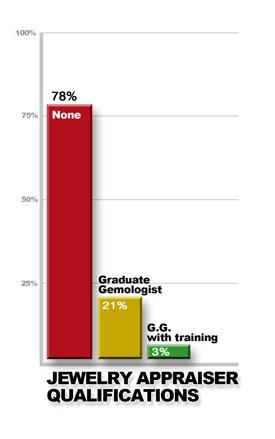
Most jewelry retailers are not even Graduate Gemologists, which means they have not pursued a six-month trade school degree that can be taken either on site or as a home study course. The course insures that the jeweler has a basic knowledge of gems and jewelry evaluation and that he is able to perform the relevant lab testing. A JCRS study of appraisals from 21 insurance companies found that only 21% of them were prepared by graduate gemologists.

Some retailers without a GG degree have learned their business on the job, but others are not even familiar with basic jewelry terminology or grading systems. Most jewelry retailers do not have a gem lab, with instruments to properly examine a stone and determine its quality. They must either rely on the word of their suppliers or simply guess. In one TV expose in London, 9 out of 10 jewelry retailers misidentified moissanite, a diamond simulant, as genuine diamond.

This lack of knowledge shows up in many insurance "appraisals," written on fancy letterhead but with no content.

One gold and diamond ring, value $2,000.

If that line looks familiar, it's not surprising--jewelers write thousands of appraisals like that every year. But such a document is useless for adjudicating a loss claim.

Even jewelers with sufficient gemological training prepare inadequate appraisals because they don't understand how the appraisal is used. Only Certified Insurance Appraisers™ (CIA™) are trained in looking at the appraisal from the insurer's perspective (see the back of the ACORD form 78/79). They understand how jewelry is insured and their appraisals include all information the insurer needs.

FOR AGENTS & UNDERWRITING

Recommend that policyholders obtain appraisals on the ACORD 78/79 forms. These appraisals are in a standardized format, making it is easy for underwriters to determine that all necessary information is included. ACORD 78/79 appraisals must be completed by an appraiser who is a Graduate Gemologist and a Certified Insurance Appraiser™. Explain to policyholders that the appraisal benefits them because it gives realistic values and it describes their jewelry in detail so the jewelry can be replaced if it is damaged or stolen.

FOR CLAIMS

If there aren't enough Certified Insurance Appraisers™ around, it's because jewelers haven't considered the training important enough. Working with a CIA™makes the insurer's job easier because all the claim information is right there on the appraisal. Ask jewelers you deal with: "Are you a CIA™?" Make it known that you are willing to refer business to CIA™s who write ACORD appraisals. Let your referrals be their incentive to get the CIA™ training.

CIA Corner

From Brandt Scholz, CIA™:

Often when I'm asked to write an appraisal for insurance, I have the opportunity to look over the appraisal that came with the jewelry purchase. It frequently turns out that these appraisals were written by retailers with no credentials other than having bought and sold jewelry. In one case, a customer brought in a ring described in her appraisal as "a 2-carat round diamond set in an engagement ring, very nice, good cut, good quality, very good color." The price was given as $15,000.

When I looked at the stone, I laughed. My idea of "very good" color was about four grades away. The customer was, of course, shocked when I told her she could buy a ring like this for $10,000. When I asked her what she thought "good cut" or "very good color" meant, she said she had no idea. I took the opportunity to explain these and other jewelry terms. I showed her the appraisal I had written and discussed the importance of the detailed description for insuring jewelry. She was so pleased with the information, and my willingness to discuss jewelry qualities, that I won her over as a customer.

Brandt Scholz
North Carolina Gemological & Appraisal
c/o Whitehall Jewelers
Hanes Mall
Winston-Salem NC 27103
336.760-1119

Brandt Scholz, who is both and goldsmith and a gemologist, has been in the jewelry business for 25 years.

NEWSFLASH UPDATE

Fake Jewelry From a Florida Jeweler

The January IM NEWS reported on a scam in Florida involving fake jewelry. Jeweler John Hasson was charged with fraud, obstruction of justice and money laundering. After a seven-week trial in Miami federal court, he was found guilty on six counts and faces 22-30 years in prison.

Hasson impressed and victimized numerous wealthy clients. He sold to pro golfer Greg Norman a custom-made diamond pin in the shape of his company's shark logo. When Norman had the piece independently appraised, he found that the pin he'd purchased for more than $48,000 was worth only $7,000.

In another scam, Hasson had his store manager's brother pose as a sheik and hired women to pose as a harem to impress millionaire Aben Johnson with his supposed connections to the Sultan of Brunci. A civil suit by Johnson claims he lost $60 million on purchases from Hasson.

Hasson created fantastic tales of historically prominent gems, while selling fakes, treated stones, or very poor quality gems. According to the FBI, this is the largest case of fraud involving gems and jewelry in US history.

Note that many of his victims were vacationing or conducting business in Florida and would insure their jewelry elsewhere. It would be worthwhile to check your files for appraisals written by John Hasson, his co-defendant Clifford Sloan, or his assistant Jimmy Speiser.


Certificates for Synthetic Diamonds

A major New York City gem lab has begun specifying natural or synthetic origin for gems it certifies. (The prominent Gemological Institute of America still refuses to grade or certify synthetic gems.) This initiative is in part a response to requests from companies that manufacture synthetic stones. They want to be able to offer customers the certificates.

See the February issue of IM NEWS for a discussion of synthetic gems.

Subscribe to Jewelry Insurance Isssues

For Insurance professionals: 8 hours CE credit. Jewelry insurance is the key to cross-selling opportunities to commercial insurance. Learn how to improve loss ratios and take advantage of value-add services for your agency.