Are Insurers Seeing Red?
— Red Diamonds, That Is
You'll probably never see a naturally red diamond in your life. But you may well be seeing red diamonds. If you're asked to insure one, look very closely at the supporting documentation.
"Red diamonds are almost priceless — and almost impossible to obtain,” says one gem industry report. Each year the Argyle mine in Australia, the largest producer of fancy colored diamonds in the world, invites a select group of buyers to bid on its finest red and pink diamonds. From the mine's annual output of some 600 million stones, a mere 60 typically make it to this select offering — a "stunningly minute” number, as an Argyle officer notes.
The gems at this exclusive showing represent the best of the best, but even these diamonds are not, strictly speaking, red. They are graded as "vivid Purplish Pink,” "intense Purplish Red,” "fancy Brownish Red,” etc.
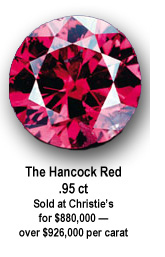 A natural diamond that is truly red is rare indeed. In 1987 the famous Hancock
red diamond, weighing less than a carat, set an auction record by selling
for $880,000, or $926,000 per carat.
A natural diamond that is truly red is rare indeed. In 1987 the famous Hancock
red diamond, weighing less than a carat, set an auction record by selling
for $880,000, or $926,000 per carat.
Only a few other red diamonds are known to exist in the world. Experts say red diamonds would now sell for more than a million dollars per carat — should any appear on the market.
But red being the attraction that it is, and fashion being the market force that it is, red diamonds are in demand. For the supply: technology comes to the rescue.
Color-Enhanced Diamonds
 Since earliest times diamonds have been coated to look red, but these coatings
could be detected easily and could also wear off. Modern techniques are more
sophisticated. Last year a British lab examined a pink diamond that turned
out to have a coating applied only to its pavilion — the lower part
of the stone. In a setting, a coated pavilion would most likely be inaccessible
to examination and the treatment would go undetected.
Since earliest times diamonds have been coated to look red, but these coatings
could be detected easily and could also wear off. Modern techniques are more
sophisticated. Last year a British lab examined a pink diamond that turned
out to have a coating applied only to its pavilion — the lower part
of the stone. In a setting, a coated pavilion would most likely be inaccessible
to examination and the treatment would go undetected.
During the 1950s technicians began using irradiation to make diamonds red, but the result was unattractive. Recent methods, involving high pressure and high temperature (HPHT) and/or irradiation, have transformed unattractive brownish diamonds into radiant yellows, greens and blues. But an attractive, saturated red remained out of reach.
Now there has been a breakthrough. Lucent Diamonds developed a method for predictably producing deep red diamonds. It involves a combination of HPHT, irradiation and annealing, a precisely controlled heating and cooling process. It markets the color-enhanced gems as Imperial Red Diamonds.
Imperial Reds, available only through custom designers and high-end stores, sell for about 1-5% the price of natural red diamond (if natural reds were available!).
Synthetic Red Diamonds
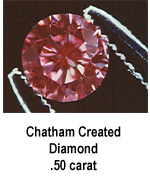
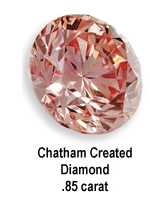 More and more gems can now be made in the lab. Red diamond, almost impossible
to find in nature, is a perfect candidate for synthesizing. And so
are the pinks. "We can grow reds now,” says Tom Chatham of Chatham
Created Gems, "but find the market wants pinks.”
More and more gems can now be made in the lab. Red diamond, almost impossible
to find in nature, is a perfect candidate for synthesizing. And so
are the pinks. "We can grow reds now,” says Tom Chatham of Chatham
Created Gems, "but find the market wants pinks.”
Synthetic diamonds are real diamonds (not imitations) that are made in a lab. They have the same composition and properties as diamonds found in nature and many synthesized diamonds are of high quality. But mined diamonds have a higher value than synthesized diamonds so, for purchaser and insurer, the distinction is crucial. See the February 2005 issue for a more detailed discussion of Synthetic Colored Diamonds.
How Red Is Red?
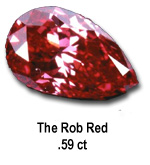
For naturally red diamonds, an important consideration is: How red is it? With all colored gemstones, the quality of the color is what most determines valuation. The price difference between red diamond and pink diamond is huge. Any departure from true, saturated red — purplish red, reddish brown, vivid pink, and so forth — draws a significantly lower price than red.
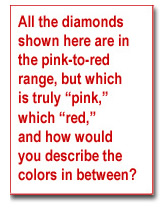
 This means the appraiser must describe the color in specific, widely accepted
gemological terminology. The appraiser must be a trained gemologist who deals
in colored diamonds and is familiar with trends in the marketplace, such
as the prevalence of color enhancements and synthetic diamonds.
This means the appraiser must describe the color in specific, widely accepted
gemological terminology. The appraiser must be a trained gemologist who deals
in colored diamonds and is familiar with trends in the marketplace, such
as the prevalence of color enhancements and synthetic diamonds.
The Imperial Reds, for example, are hard to recognize unless one knows what to look for. Diamond grading labs can detect the treatment by its distinctive inclusions, color zoning, fluorescence and unique spectroscopic features. The appraiser must have the knowledge and equipment to examine the stones properly and to distinguish color-treated stones and synthetic stones from natural red diamonds.
Disclosure!
Every Imperial Red Diamond is laser-inscribed on its girdle by Lucent Diamonds. This inscription should be noted on the appraisal. However, since laser inscriptions can easily be polished off, the absence of such an inscription is not significant. The appraiser must examine the stone and independently determine whether it is naturally colored or color enhanced.
Each Lucent red diamond that is over .5 carat in weight comes with a certificate from the Gemological institute of America (GIA) or the European Gemological Laboratory (EGL), stating that it is natural diamond that has been color treated. But if this identifying paperwork gets "lost,” an unscrupulous seller could supply a certificate from an unreliable or fictitious lab.
Imperial Reds are the first color-enhanced red diamonds to hit the market. There will undoubtedly be more, as other companies perfect their techniques. Even at 5% the price of the extremely rare naturally red diamond, jewelry with color-treated reds is still a significant purchase (and could mean a significant payout). It's essential that the color treatment be disclosed on the appraisal.
FOR AGENTS & UNDERWRITERS
A treated diamond is worth far less than one that is naturally colored. Disclosure is essential.
A synthesized colored diamond is worth far less than a natural fancy colored diamond. Disclosure is essential.
Naturally colored diamonds are rare and naturally red diamonds are extremely rare. Don't assume that a diamond you are insuring is naturally red. Most likely it is color-treated or synthetic, and this should appear on the appraisal.
 The appraisal should explicitly state that the stone is natural
and untreated; or it should state that it has been color treated or "enhanced;” or
it should state that the stone is synthetic.
The appraisal should explicitly state that the stone is natural
and untreated; or it should state that it has been color treated or "enhanced;” or
it should state that the stone is synthetic.
A red diamond, whether treated or naturally colored, should come with a diamond certificate from a reliable independent lab, such as Gemological institute of America (GIA) or the American Gemological Society (AGS). Certificates from other labs may not be reliable.
GIA does not certify synthetic diamonds.
Beware of appraisals supplied by the seller. Insist on a JISO 78/79 appraisal (formerly ACORD 78/79), the insurance industry's standard for detail and accuracy.
FOR ADJUSTERS
Natural fancy colored diamonds, especially reds, are very rare and very expensive. Color enhanced diamonds and synthetic colored diamonds are available for a fraction of the price of natural fancies.
Inspect the appraisal and diamond report carefully for terms suggesting that the stone has been color enhanced or treated. Such information is sometimes not obviously stated, but this is an instance when one word can mean a tremendous difference in valuation!
Check for terms indicating the stone is lab-made, such as synthetic, cultured, created, grown, and lab-grown.
Check appraisal documents for brand names, which can help determine quality and verify valuation. It may be useful to consult a jewelry insurance expert.
Any colored diamond approaching .5 carat should come with a certificate from a reputable independent laboratory, such as the GIA Gem Trade Lab or AGS Labs. (GIA does not certify synthetic diamonds.)
©2000-2024, JCRS Inland Marine Solutions, Inc. All Rights Reserved. www.jcrs.com
Subscribe to Jewelry Insurance Issues