It’s Art – But Is It Jewelry?
or When Gems Go Beyond Jewelry
Most of the gemstones most of us see are traditionally cut stones in familiar-looking jewelry. Then there are the exceptions.
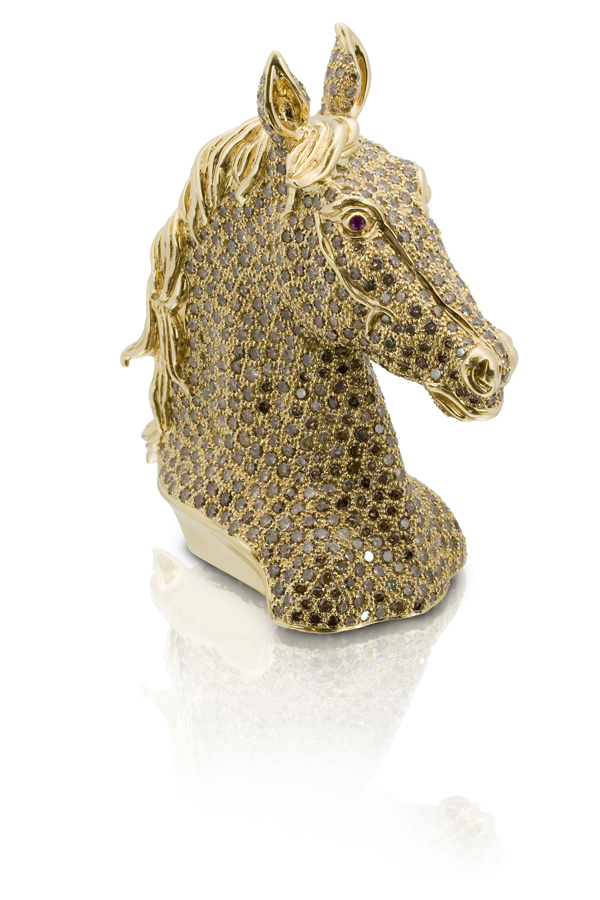 |
If this horse crossed your path, you’d recognize it as something special. The 18K yellow gold head is set with 49 carats of multi-colored diamonds and ruby eyes. Although the diamonds are not of particularly high quality, the 6”-tall piece sells for $28,000. (Click photo to enlarge) |
| Fabergé eggs are world renowned, regarded as masterpieces of the jeweler’s art. Peter Carl Fabergé produced at most 57 eggs for the Russian tsars between 1885 and 1917, each one a unique creation intricately crafted in precious metals, enameling, and gems. Many of the original eggs were lost in the Russian Revolution, and the remaining ones are in museums or private collections. In 2004 the Forbes collection of 9 Fabergé eggs sold at auction for $90 million — $10 million per egg. (Click photo to enlarge) | 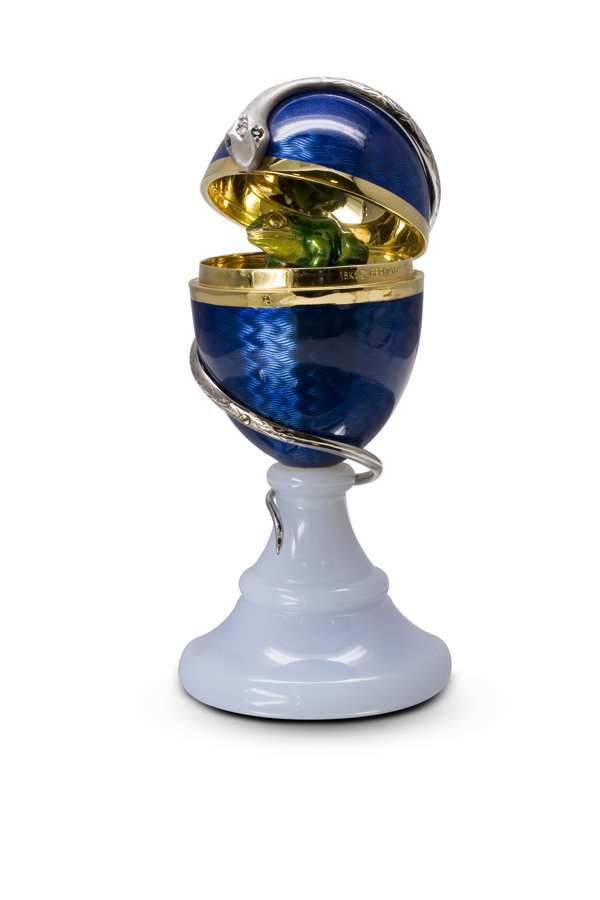 |
In the 1920s, the Fabergé family sold rights to the name to an Anglo-Dutch conglomerate, which now produces Fabergé cosmetics and jewelry, as well as Fabergé eggs. The name still has cachet, but the eggs are made as limited editions, instead of one-of-a-kind, and their value is not stratospheric. This example, 3-1/2” tall including its chalcedony quartz base, has a diamond-headed emerald-eyed serpent twining around an enameled egg, which opens to reveal an enameled frog. From an edition of 75, it sells for $15,860.
This Fabergé license was for “precious metal works.” Others have Fabergé licenses for non-precious metal works, and still other manufacturers are making cheap knock-offs. On the Internet, for example, you can find “Fabergé eggs” for $50. Insurers must be sure such pieces come with an appraisal from someone who is expert in appraising in this field (both identification and valuation).
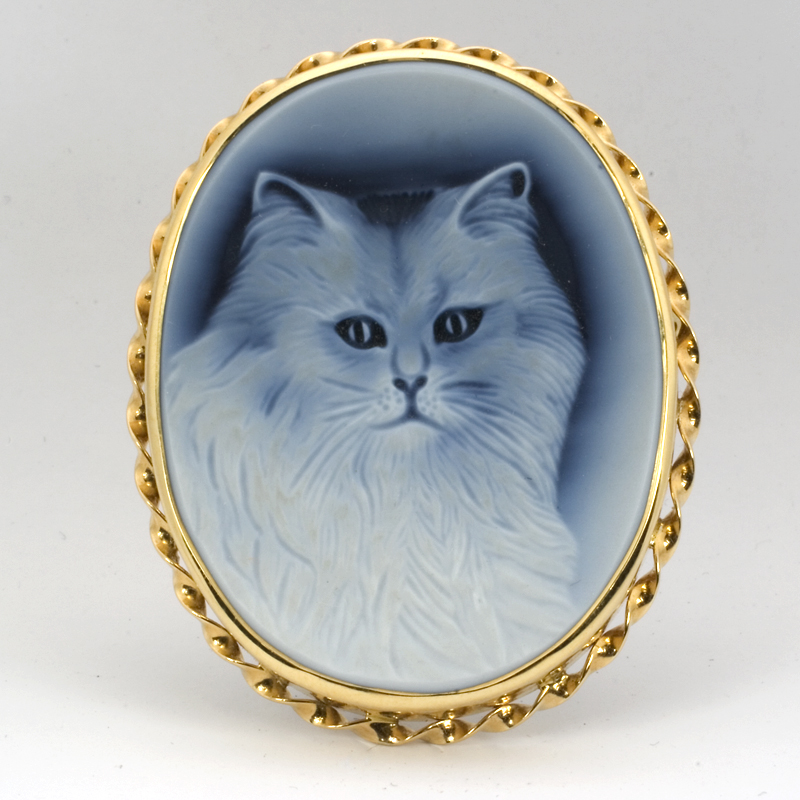 |
A programmed machine was used to carve this onyx brooch, based on a portrait supplied by the customer. Ultrasound cut through a white layer of the stone into a dark layer to give depth. The 2”-high piece sells for $600. Such a brooch carved by hand would sell for about $1,600. (Click photo to enlarge) |
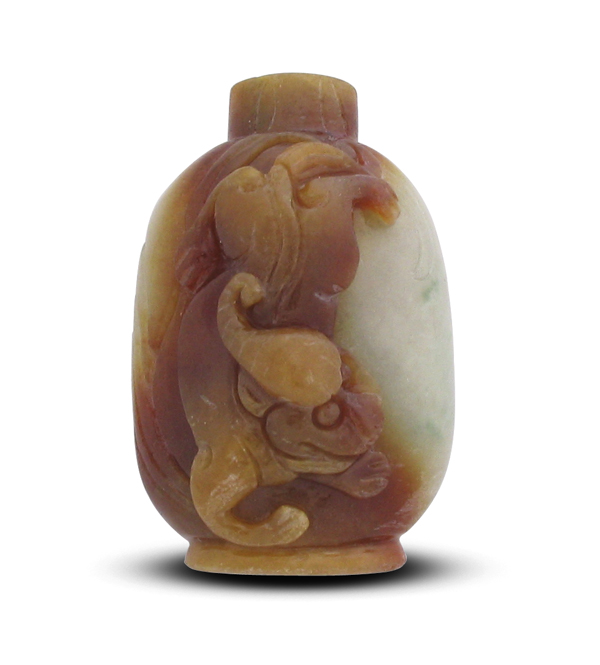
A little snuff bottle — just 2" tall — is valued at $1,200. It is a carved piece of brown and white jadeite. The quality of the material, as well as the workmanship, determines the value. The finest jadeite, called imperial jade, is rare and expensive. A 9x12mm piece in a ring, for example, might be worth $100,000. (Click photo to enlarge) |
 |
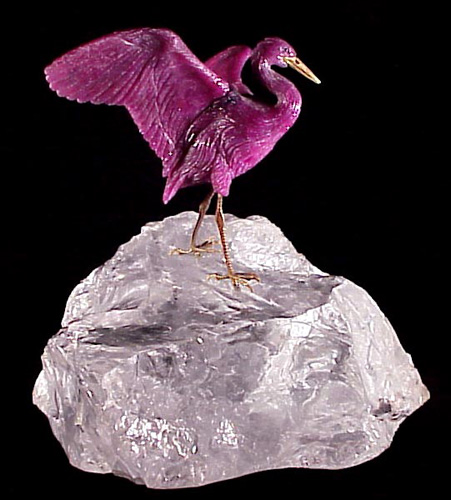 |
This heron of carved ruby has 18k gold legs and beak. The piece stands 5-1/2” high, including its rock-crystal quartz base. It is the work of Gerhard Becker of Idar-Oberstein, Germany, and sells for $6,500. For more than 500 years Idar-Oberstein has been known worldwide for its rich tradition in fine gem-cutting. (Click photo to enlarge) |
Cutters hone their craftsmanship through years of training and apprenticeship. Gem connoisseurs go to the Intergem fair in Idar-Oberstein each year to see and acquire some of the most extraordinary gem pieces in the world. The work produced in this region is considered to be superior in every way.
So Where’s the Jewelry?
Jewelry is defined as articles of personal adornment composed in whole or in part of silver, gold, platinum or other precious metals or alloys. The items shown here are obviously not objects for personal adornment. They are clearly works of art, so what have they got to do with jewelry?
Like jewelry, these items would most likely be insured under a Personal Articles Floater. The PAF is sometimes called a jewelry floater—but this shorthand term may lead you to overlook the policy’s broader purpose.
The PAF policy was developed in 1953. Well into the sixties, insurance journals carried discussions of what exactly would be covered in a PAF.
The classes originally covered by the PAF were jewelry and furs, fine arts, cameras, golfer’s equipment, musical instruments, silverware, stamps and coins.
Today the list has expanded to include other sporting equipment, artificial eyes and limbs, hearing aids and medical devices, chain saws and hand tools, collectibles, bicycles, computers and cell phones.
Insuring Fine Art at the Jewelry Rate
Jewelry is by far the largest property class insured under PAF. Insurance regulations state that certain items other than articles for personal adornment may be insured at the jewelry rate.
Small works of art, unlike a bulky statue or painting, are particularly vulnerable to theft because (like jewelry) they are highly valuable and easily portable. These pieces would still be classified as fine art, but you would rate the risk as though they were jewelry, rather than using the much lower rate for fine art.
FOR AGENTS & UNDERWRITERS
Appraising such pieces requires expertise beyond that of the average graduate gemologist. You should get an appraisal from someone who deals in such objects, who can judge the craftsmanship, who recognizes the work of various producers, and who knows the market.
For pieces that are unique and irreplaceable, consider writing a valued contract.
FOR ADJUSTERS
The pieces discussed in the article are all unique (except the Faberge egg, which is from a limited edition of 75). If a unique piece is a total loss, you have few options other than issuing a check.
If a unique piece is damaged, have it examined by an expert. Some kinds of damage can be repaired. In some cases, the piece would lose value if repaired. Only an expert can make this call.
Even if you pay it as a total loss, always take possession of the salvage. You may be able to have the piece repaired, then sell it. Or you may offer it for sale to an expert, who will assume the risk, repair it. and sell it for his own profit. Or the piece may be irreparably damaged but have component gems or metals that still have value.
If a piece has sentimental value, you could (after paying for a total loss) offer to return the damaged piece to the insured for a determined recovery amount. The amount may be little more than the material’s scrap price, but the transaction will gain the policyholder’s good will. Be sure to have an expert establish a fair as-is price.
©2000-2024, JCRS Inland Marine Solutions, Inc. All Rights Reserved. www.jcrs.com
Subscribe to Jewelry Insurance Issues