 Good as Gold
Even a professional jeweler can't tell the difference between 10 karat, 14 karat and 18 karat gold, just by looking at it. What's an untrained customer—or insurer—to do?
Gold jewelry is sold just about everywhere—on TV shopping channels, through mail-order catalogs, in department stores, flea markets and fine jewelry stores. Gold earrings or a simple chain necklace can be found in a wide range of prices. What makes the price differences? How is value determined?

Karatage
Karatage describes the gold content of jewelry. Pure gold is stated as 24 karat (24K). Gold in its pure state is seldom used for jewelry because it is too soft. It is combined with other metals, or alloys, to produce a more durable metal. The finest gold jewelry is 18 karat. This means the piece is 18/24 or 75% pure gold (and 25% alloy).
 U.S. law does not require labeling the gold content of jewelry. However, the law does come into play once the jewelry is labeled "gold." To be called "gold," a piece must be at least 10K (or 10/24) gold. This law also applies to gold-filled, gold plate, and gold vermeil—all of which involve bonding gold to another metal.
Karatage is usually stamped on the piece, since it is a selling point and something the manufacturer wants to be known. Buyers and insurers should be suspicious of any jewelry described as "gold" that is not stamped with the karatage.
Trademark
Any jewelry that is stamped with the karatage (such as "14K") must also bear the manufacturer's trademark or hallmark. The purpose of this law is that if underkarating occurs, the trademark helps trace the offending item to its source. The name of the manufacturer should be given on the appraisal.
Underkarating
The most reliable test for determining karatage is the fire assay, in which a piece of the gold is melted down and separated from its alloys. Since this destroys the jewelry, it is used only in cases where fraud is suspected. In general, jewelers and their customers rely on the manufacturer's statement of the gold's purity. This is why knowing the manufacturer is an important part of valuing gold jewelry.
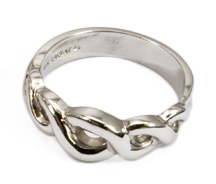 Die-struck |
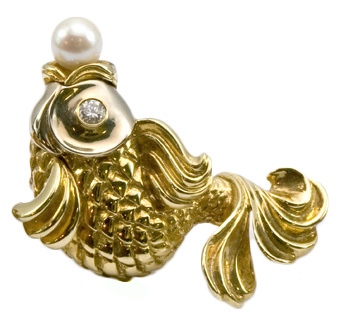 Cast |
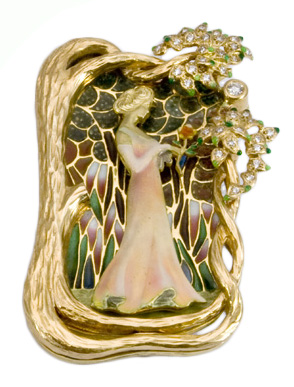 Cast and hand-assembled |
Workmanship
The workmanship of gold jewelry is crucial to its valuation. Today's jewelry is usually machine-processed in some way. Modern methods have eliminated much of the time-consuming handwork, making fine jewelry accessible to more people.
Expect the appraisal to list the jewelry's workmanship, using terms such as cast, die-struck, cast & hand assembled, machine-made or, in uncommon instances, handmade. Within each category there are also differences in quality. For example, detail and definition tend to get lost as manufacturers copy each other's work.
 Weight
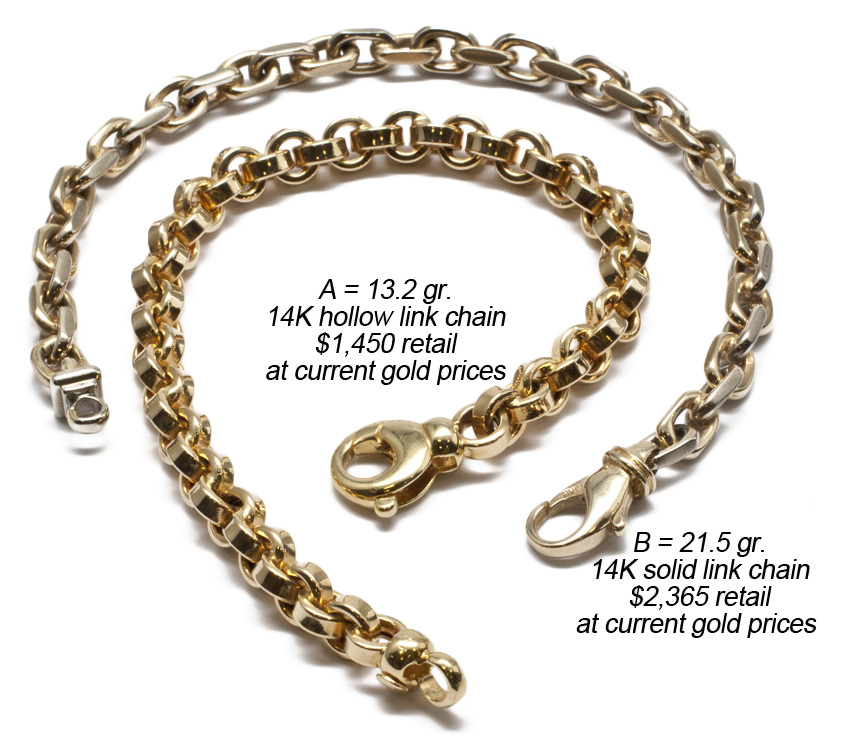
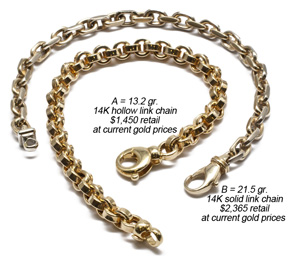
Two gold chains of the same karatage and workmanship will vary significantly in price if one weighs 13 grams and the other 21 grams. Jewelry worn on the wrist or hand, such as a ring, bracelet or charm, takes a lot of abuse in everyday wear; such a piece should have some weight to it for practical reasons, as well as for value.
Sometimes retailers quote price-per-gram in their sales promotions, making it easy for customers to comparison shop. Most national and local jewelry stores are prepared to weigh gold jewelry, while flea market vendors are not.
See the chart for gold prices, historic and recent.
FOR AGENTS & UNDERWRITING
An appraisal for jewelry containing gold should include karatage, manufacturer and style number, workmanship, and weight of the piece.
Appraisals often lack the manufacturer and style number. However, this is exactly the information the adjuster needs to price a replacement and you should insist it be on the appraisal.
A professional jewelry retailer will be able to weigh gold jewelry. Since weight is an important determinant of value, be sure this information is on the appraisal.
FOR CLAIMS
If there is inadequate information in the insurance files, perhaps a poor appraisal or just a sales receipt, try calling the jeweler to see if he can provide more information. Jewelers often keep notes on the pieces they carry and sell. (However, you may get no cooperation from the jeweler. Or he may embellish the quality of the piece, with the intention of helping the customer, so use caution.)
If you know where the item was purchased, you can analyze the type of merchandise the store normally carries. For example, mall chains such as Zale's carry mostly cast, light weight jewelry with lesser quality workmanship. If the sales receipt carries little information, you can fill in the blanks with factual assumptions based on the store's general merchandise.
©2000-2024, JCRS Inland Marine Solutions, Inc. All Rights Reserved. www.jcrs.com
Subscribe to Jewelry Insurance Issues